Insight · TNB supply
TNB supply for factories: substations, maximum demand and the approvals behind them
For a factory, the TNB supply application is a project in its own right. Get it wrong and the machines arrive before the power does. Get the maximum demand wrong and you pay for it every month for years.
Small workshop or large plant?
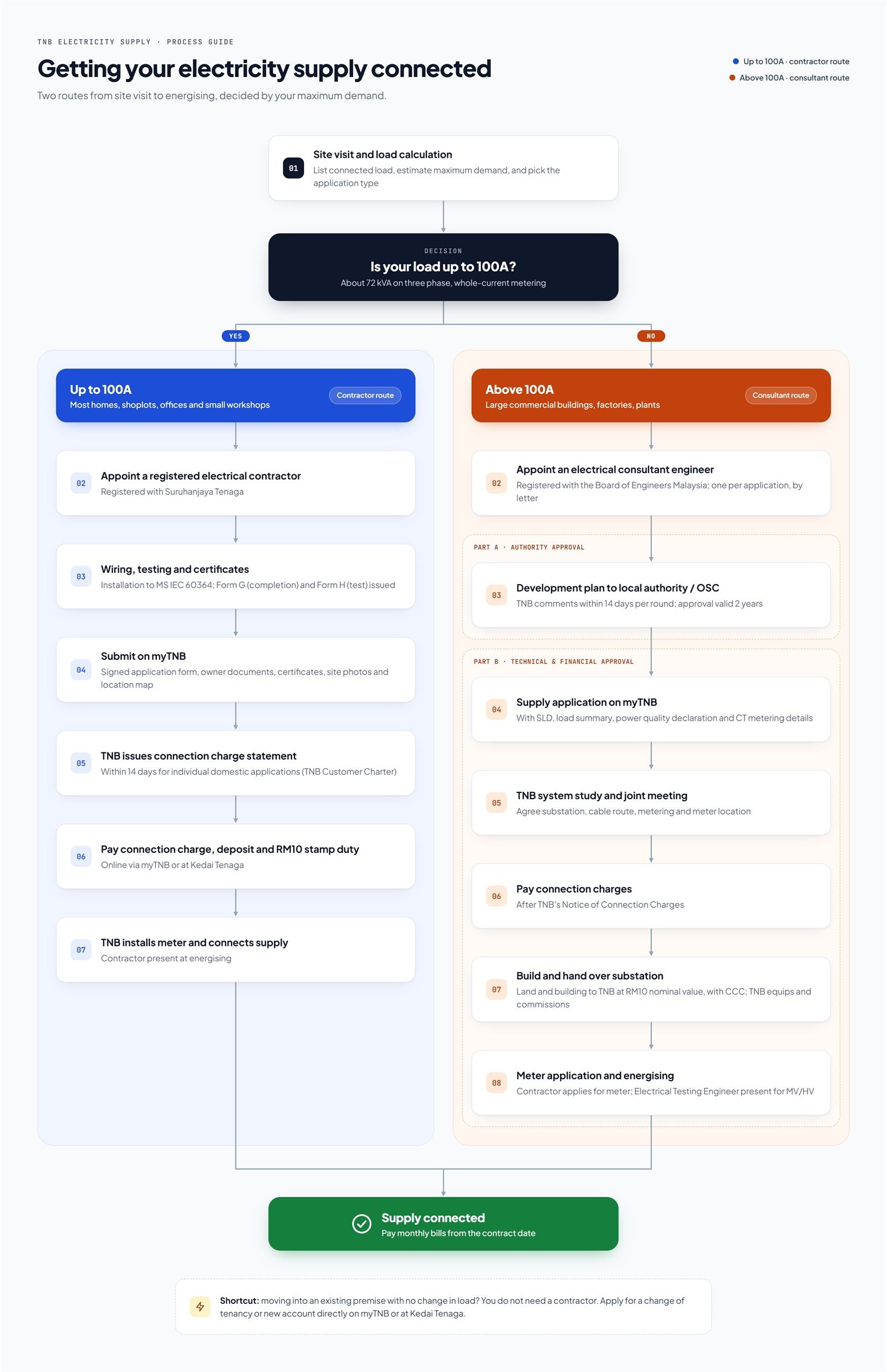
The split is at 100A (about 72 kVA, three phase).
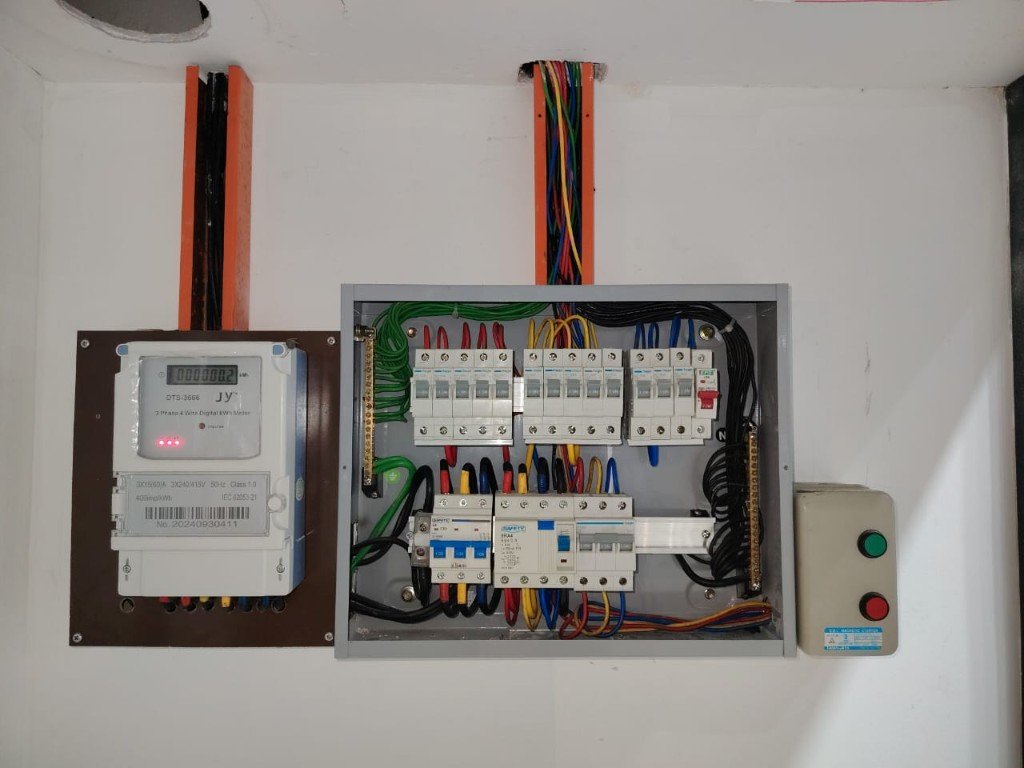
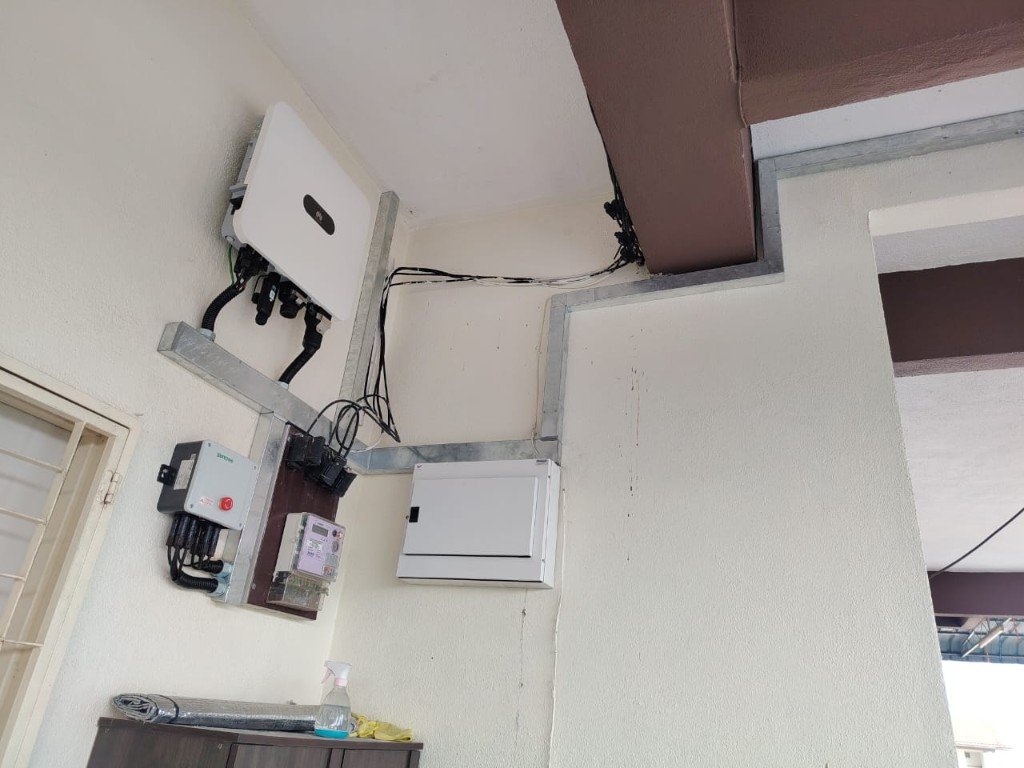
- Up to 100A: a small workshop follows the same route as a shoplot. A registered electrical contractor submits the application on myTNB.
- Above 100A: an electrical consultant engineer registered with the Board of Engineers Malaysia must be appointed, one per application, by letter. The application then runs in two parts.
Part A: authority approval
The consultant submits the development plan to the local authority or One Stop Centre. TNB reviews it, decides how it will supply you, and agrees technical requirements with the consultant: the number, size and location of substations, and the main switchroom. TNB comments within 14 days per round, and its approval stays valid for 2 years.
Part B: technical and financial approval
- The consultant submits the supply application on myTNB with the approved plans, single-line diagram, load summary, power quality declaration and CT metering details.
- TNB runs a system study and holds a joint meeting to fix the substation, cable route and metering.
- TNB issues a Notice of Connection Charges, which the owner pays.
- The owner builds and hands over the substation.
- The contractor applies for the meter, and supply is energised. An Electrical Testing Engineer must be present for medium and high voltage.
The substation
If TNB needs a substation, the owner provides the land and building and either transfers or leases the land to TNB at a nominal RM10, with the Certificate of Completion and Compliance. If the land title is not ready, TNB asks for a 12-month bank guarantee, renewed until the transfer is done. The owner also provides cable trenching from the substation to the main switchroom.
Which voltage?
| Maximum demand | Supply |
|---|---|
| Up to 1,000 kVA | 400V, CT-metered |
| 1,000 – 5,000 kVA | 11kV |
| 5,000 – 25,000 kVA | 33kV |
| Above 25,000 kVA | 132kV or 275kV |
Declare your maximum demand carefully
At medium voltage, the connection charge is RM45 per kW of declared maximum demand, where the site is within 6 km of available supply. After connection, TNB can impose a connected load charge of RM8.50 per kW if your actual demand falls short of the reference demand, for up to 6 years. If you stop taking supply within 5 years, liquidated damages apply.
Over-declaring to be safe is expensive. Under-declaring limits your expansion. A proper load study, with realistic diversity factors for motors and process loads, is the cheapest insurance you can buy.
After you are connected
Industrial customers must keep their power factor close to 1.0. A surcharge applies below 0.85. Transformer-operated welding sets attract an extra charge. Your installation must also tolerate voltage sags and transients without disturbing TNB’s network. This is why power factor correction and good switchboard design matter from day one; see our palm oil mill switchboard insight.
Lead times to plan around
- 400V with substation: 3 to 12 months
- 11kV: 6 to 12 months
- 33kV: 18 months to 2 years
These assume no delay in local authority approval. Start the TNB process when you start the building plan, not when the machines are ordered.
Planning a new plant or expansion? Our TNB supply application page sets out the full process. We handle the installation, testing and meter application, and work alongside your consultant engineer.
Sources: TNB ESAH, supply application; TNB, Supply Application for Housing Developers & Electrical Contractors; TNB Connection Charges; TNB Terms and Conditions of Supply (clauses 41–48).