Insight · Wiring & power
When the power stops, the fruit doesn’t wait
A palm oil mill runs almost non-stop during peak crop. Free fatty acid rises with every hour of delay — so the electrical backbone is a production asset, not a utility.
The scale of the problem
Sterilisers, threshers, digesters, screw presses, clarifier pumps, kernel plant and boiler fans all run on motors — and all of them stop when a board trips. This project delivered the low-voltage distribution of a working palm oil mill: a new 415 V main switchboard in a dedicated switch room, a sub-switchboard on the process floor, automatic power factor correction at both, and the heavy-duty cabling that ties them together.
Project at a glance
| Item | Detail |
|---|---|
| Facility | Palm oil mill (unnamed) |
| System voltage | 415 V, 3-phase 4-wire, 50 Hz (low voltage) |
| Main switchboard (MSB) | Floor-standing, multi-section: incomer, metering, MCCB feeders, MCB chassis, integrated APFC |
| Sub-switchboard (SSB) | Wall-mounted on the process floor with digital metering and APFC section |
| Power factor correction | Automatic multi-step APFC at MSB and SSB |
| Main cabling | Single-core copper power cables, parallel runs per phase, R/Y/B + neutral identification |
| Containment | Overhead galvanised cable tray in switch room; trench bottom entry; trunking at SSB |
The main switchboard
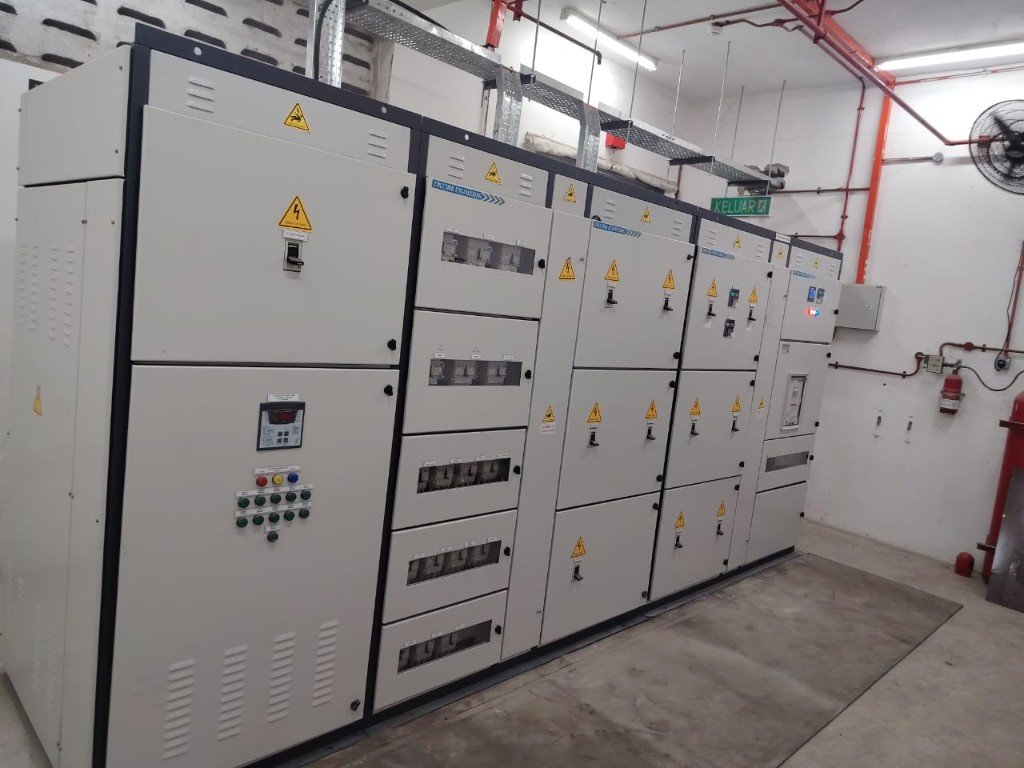
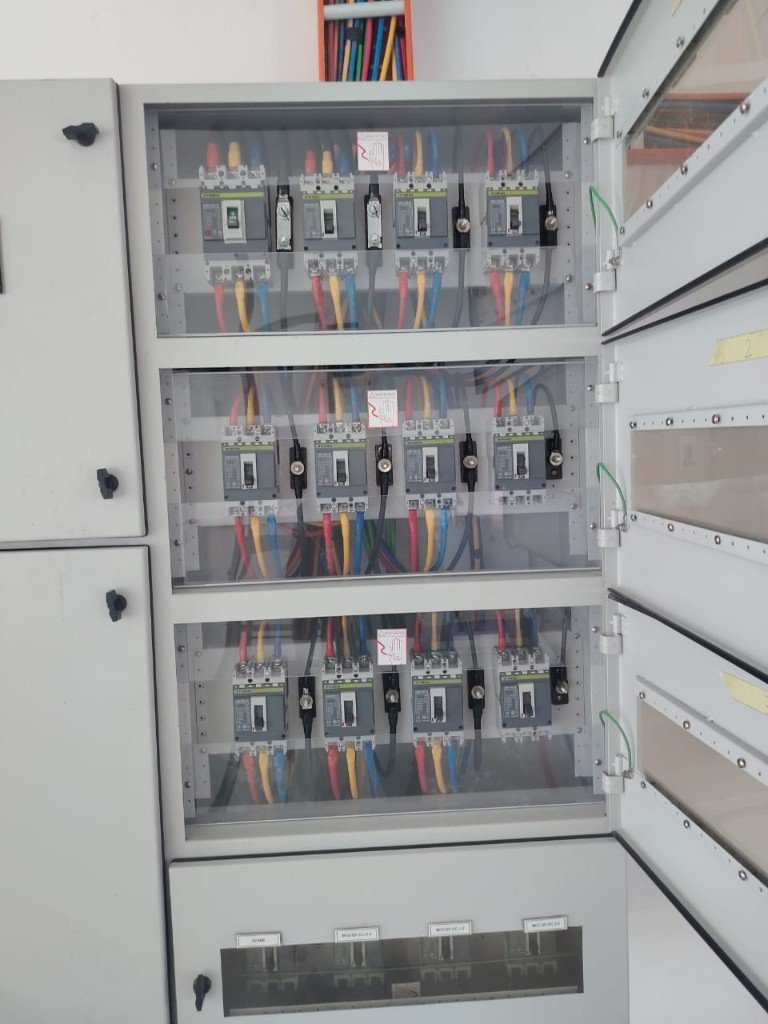
Kept away from dust, heat and moisture of the process hall, the MSB reads left to right as a production tool: APFC with regulator and step lamps behind louvred doors; MCB chassis for lighting, small power and control; MCCB outgoing feeders with padlockable handles so one line can be isolated while the mill keeps running; and digital multifunction metering at the incomer. Overhead tray, ventilation and a clear exit route make the room a proper electrical space.
Process-floor sub-board
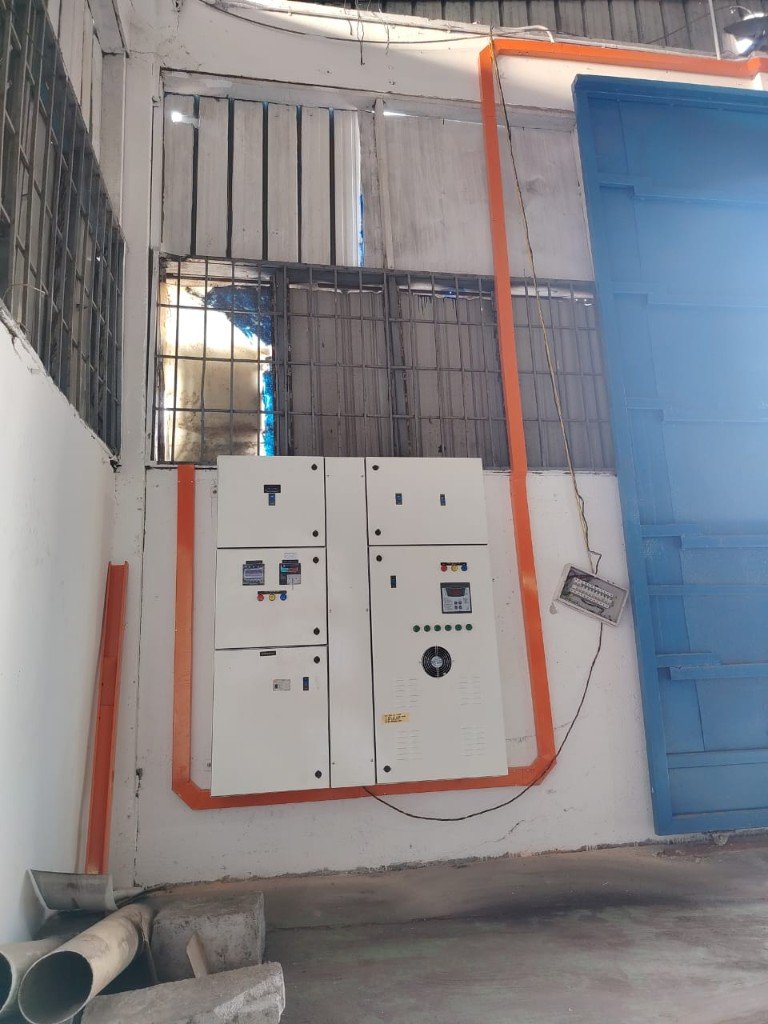
Closer to the machines, the wall-mounted SSB distributes locally and corrects power factor at the point of use — incoming metering and R/Y/B indication on one side, multi-step APFC with forced-ventilation fan on the other, orange trunking for neat cable routes into and out of the board.
Heavy-duty cabling and terminations
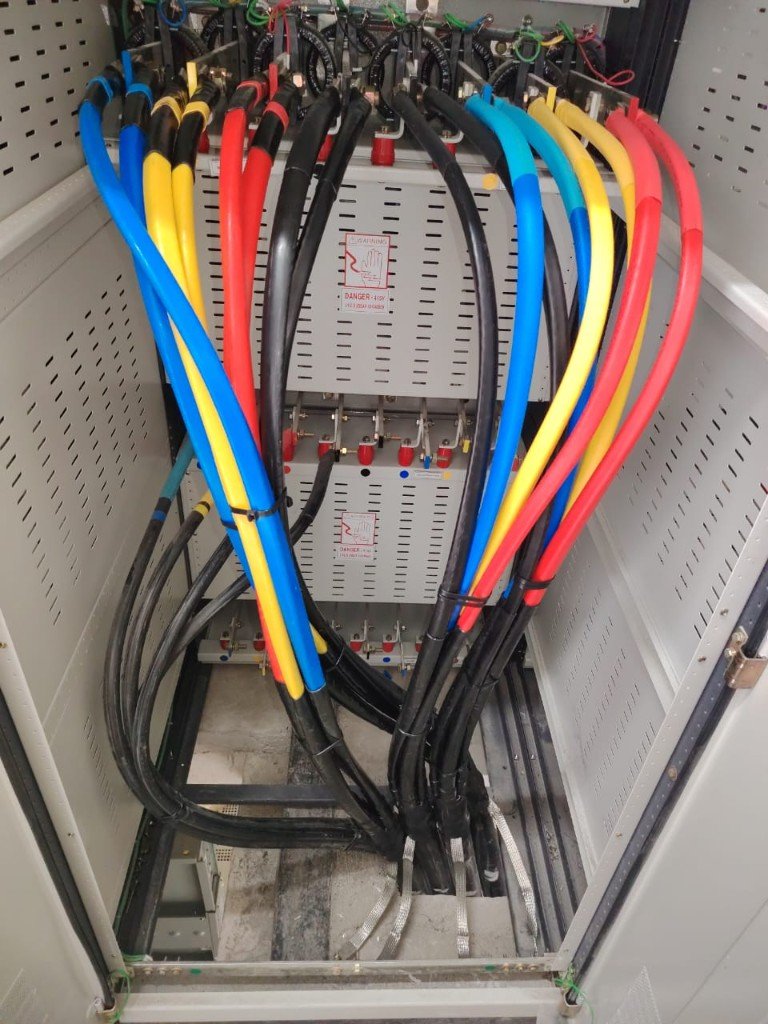
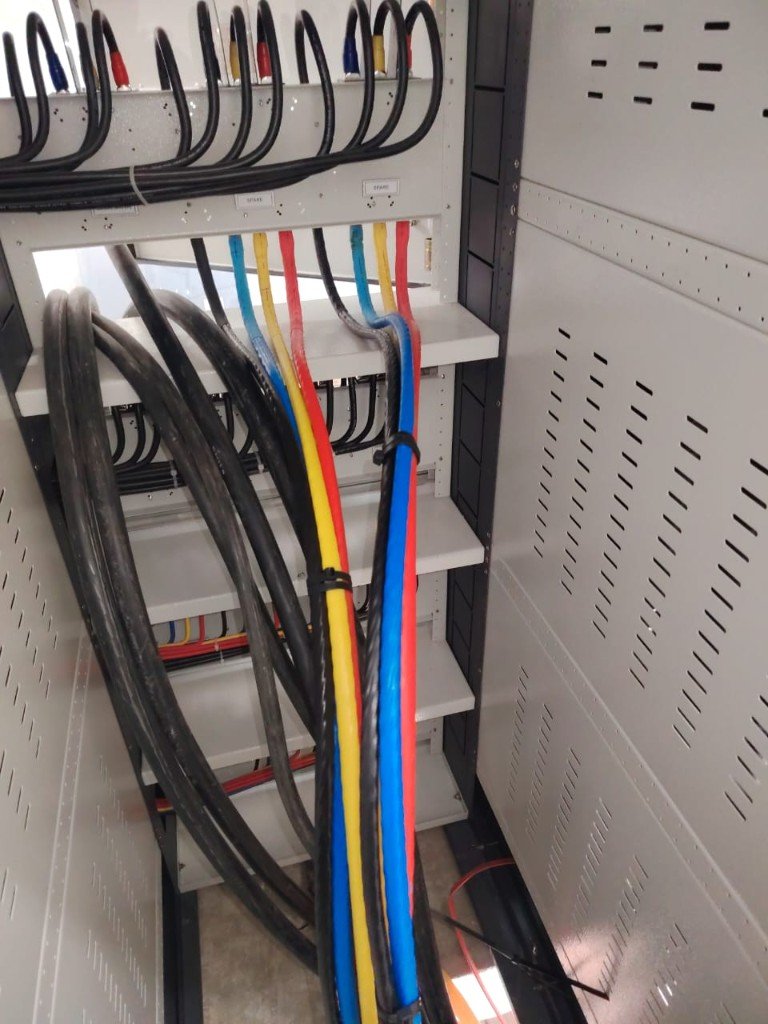
Main cables enter from a floor trench and rise to the busbar terminals. Parallel single-core copper runs per phase carry high current without oversized, hard-to-bend conductors. Every core is sleeved in phase colour; CTs feed meters and protection; tinned-copper braid bonds glands to the earth bar; perforated barriers segregate the live busbar chamber from the cabling space.
Why power factor correction pays for itself
Motor-heavy mills draw reactive power that pulls power factor down. TNB can surcharge three-phase LV industrial customers when power factor falls below 0.85. Automatic capacitor stages track presses, digesters and fans as they start and stop — avoiding surcharge, cutting losses and freeing transformer and cable capacity for future load. Exact surcharge maths should always be checked against the current TNB schedule and the client’s bill.
Engineering for a mill environment
| Mill condition | Risk | How this installation answers it |
|---|---|---|
| Heat from boilers and sterilisers | Overheats capacitors and breakers | Louvred / fan-cooled APFC; MSB in a separate ventilated switch room |
| Fibre dust and oily residue | Tracking and fire risk on busbars | Enclosed boards, segregated busbar chamber, switch room away from process |
| Large motor loads starting and stopping | Swings in current and power factor | Multi-step automatic capacitor switching |
| 24/7 peak-crop operation | Little shutdown time | Individually isolatable, lockable MCCB feeders |
| Mixed crews and contractors | Wrong-phase / unsafe isolation | Full R/Y/B/N sleeving, danger labels, padlockable handles |
Testing, commissioning and compliance
Boards are not energised until tested and documented. Typical sequence for this class of work includes torque checks, insulation and continuity, phase sequence, earthing, CT and meter verification, protection settings, APFC step proving and a thermal scan under load. Work is carried out by an Energy Commission (Suruhanjaya Tenaga) registered contractor under the Electricity Regulations 1994, with switchboards built to MS IEC 61439. The client receives test reports and as-built drawings at handover.
What mill owners should take away
- Check power factor on every TNB bill — below 0.85 you may be paying a surcharge a capacitor bank can usually eliminate.
- Keep the MSB out of the process hall — a ventilated switch room protects your most critical asset from heat and fibre dust.
- Design for maintenance in season — lockable, individually isolated feeders let you fix one line without stopping the mill.
- Insist on identification and documentation — colour-coded cables, labelled feeders and test reports save hours in every breakdown.
See the project gallery
Photos and a short project summary: Powering a palm oil mill — LV switchboards, PFC & heavy-duty cabling.