Insight · TNB supply
TNB supply for shoplots, offices and restaurants: the commercial checklist
A new restaurant can sit idle for weeks waiting for a meter. Commercial TNB applications follow the same route as homes up to 100A, but ask for more paperwork, and the limit catches many businesses by surprise.
What is different from a home application
More documents. Besides the signed application form and proof of occupation, a business provides:
- its registration certificate, such as Form 9 (company), Form D (business), or a JMB/MC certificate
- a letter of authorisation on company letterhead naming the person who signs, with that person’s IC
- proof of land ownership, or the landowner’s consent
- a development order from the local authority
The last two are required for premises with commercial and industrial activities under the amended Electricity Supply Act. If you rent, ask your landlord for the consent letter early. It is the document most often missing.
A different tariff. Since 1 July 2025, TNB bills customers as domestic or non-domestic, by voltage level. Most shoplots and offices fall under non-domestic low voltage. The old separate commercial tariffs (B, C1, C2) were retired in the restructure.
A power factor surcharge. Non-domestic customers pay a surcharge when their monthly power factor falls below 0.85. Restaurants with heavy refrigeration and air-conditioning should watch this.
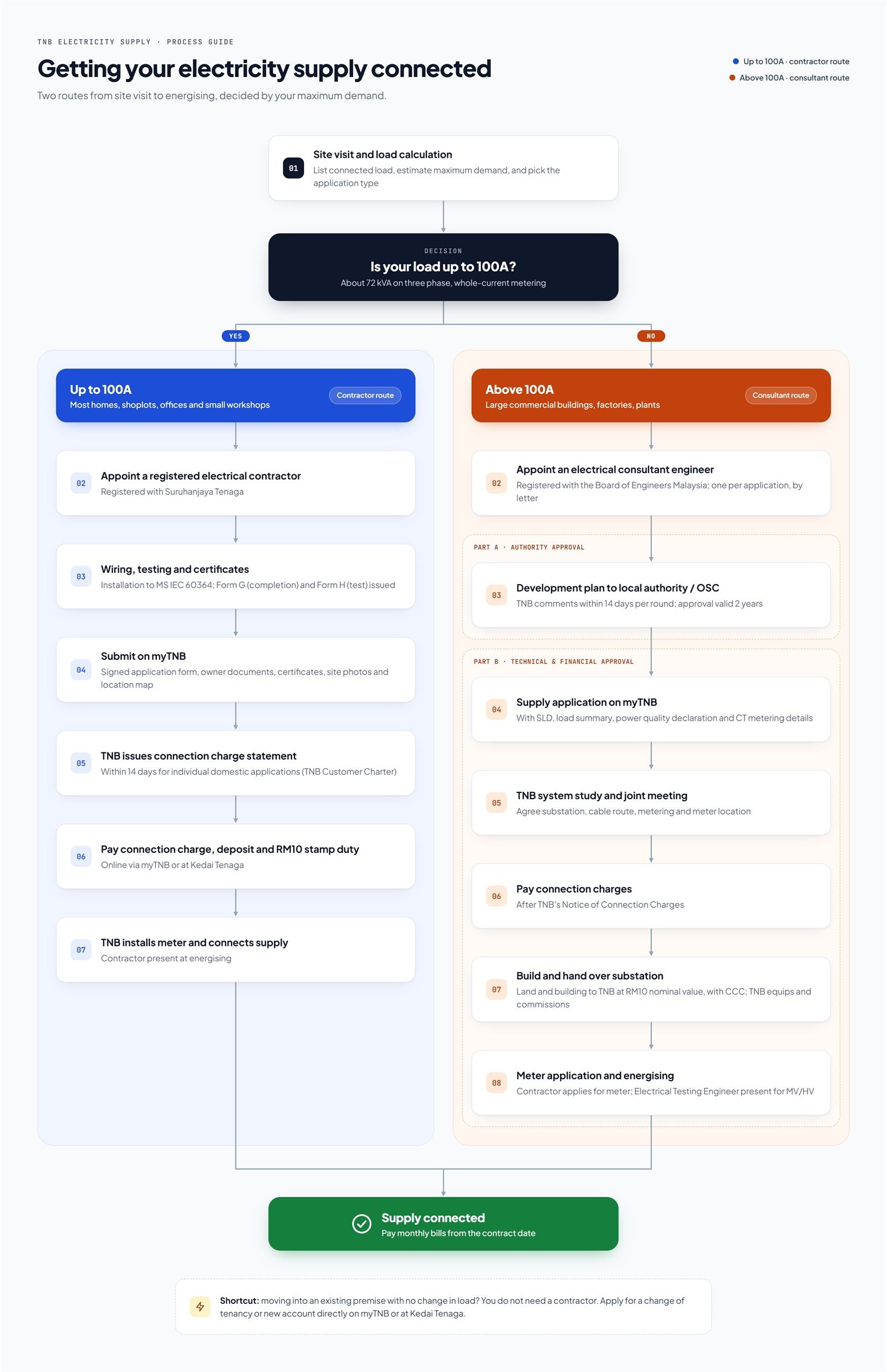
The 100A line
A three-phase whole-current supply covers a maximum demand of up to 72 kVA (100A). That is enough for most shoplots, clinics and small offices.
A restaurant with a commercial kitchen, a cold room and several air-conditioning units can exceed it. Above 100A, the rules change:
- an electrical consultant engineer registered with the Board of Engineers Malaysia must handle the application
- TNB may need a substation, with land and building provided by the owner
- metering moves to CT-metered low voltage, up to 1,000 kVA
So the first question for any commercial fit-out is the load. Get it calculated before you sign for kitchen equipment.
Shared buildings
In malls and multi-tenant blocks, the landlord’s supply and each tenant’s supply are metered and billed separately by TNB. The building owner must provide and maintain the rising and lateral mains. As a tenant, check with management where your meter will sit and whether the riser has spare capacity before you commit to a heavy load.
Typical timeline
Under 3 months for low-voltage supply without a substation. With a substation, 3 to 12 months.
Opening a new outlet? See our TNB supply application service for the full process, documents and charges, or WhatsApp us with your floor area and equipment list.
Sources: TNB ESAH; ESAH Appendix 2; TNB Terms and Conditions of Supply (clauses 20 and 42); TNB, Supply Application for Housing Developers & Electrical Contractors; The Star, 24 June 2025.